NinerNet‘s offices will be closed from Tuesday 1 August and will re-open on Monday 7 August. Emergency support will continue to be available 24/7, but routine emails and enquiries will be dealt with on Monday 7 August. Thank-you.
This is a long post, but certain sections of it might be useful to you.
We have been hearing from some clients over the last few months that they are being inundated with spam advertising weight loss drugs, diet pills, etc. ad nauseam. NinerNet does have anti-spam measures on our mail servers — and they stop thousands of messages a day that you never see — but they generally rely on methods of filtering that do not involve what is called “content scanning” — i.e., having a machine essentially read all of your email to see if it mentions topics you don’t want to hear about. They also don’t generally involve blocking email addresses, as spammers almost always send from a different email address every time, so blocking one email address after the fact is pointless.
Additionally, what is a clear indicator of spam for one client can be part of a perfectly legitimate email for another client: for example, a medical client might send and receive completely legitimate emails that include the word “diet” or the phrase “weight loss”, and so we can’t filter for those words across the entire server. Even everyday communications can contain these words when one person enquires after another person’s health, even in a business email: “How’s the diet going?”; “Bob has experienced significant weight loss since he got sick last month”; and so on. In other words, if we deleted all messages containing the word “diet”, for example, we’d delete a lot of legitimate email and upset a lot of clients.
Then there are spelling mistakes: If we delete email containing the phrase “diet supplement”, we’ll miss the misspelling “diet suplemment”.
So what can you do? Potential solutions fall into two categories — prevention and cure — and we all know that an ounce of prevention is worth a pound of cure. We’ll deal with prevention first, but if it’s already too late for you, skip right to the (potential) cures at the end.
In truth, there is no cure. If your email address is on a spammer’s list, it’s going to be sold and traded on. But no matter how well you do on the prevention side, someone else who has your email address on their computer is going to allow a virus in, and your email address will end up on a list.
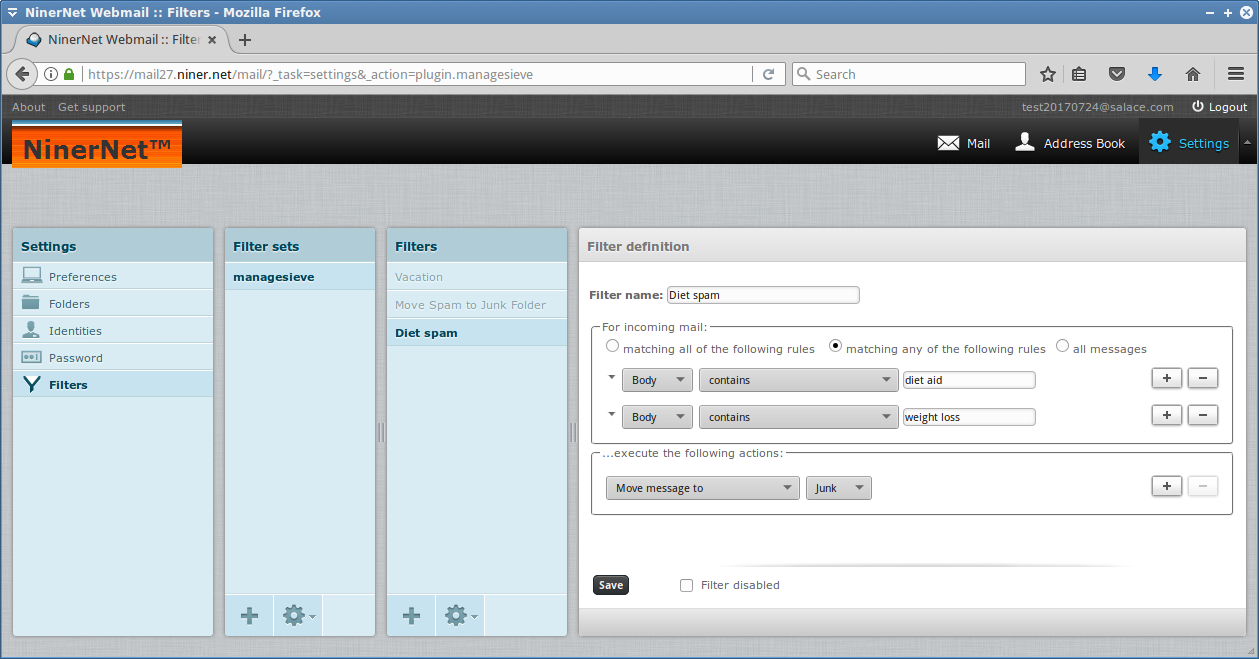
However, on the particular topic of this blog post — weight loss spam — if no legitimate email coming into your account is going to refer to “diet pills” or “weight loss”, then you can set up a filter in your webmail account. Follow these instructions (illustrated at right):
Now emails matching the filter you have created will automatically be filtered to your “junk” folder. We suggest that you check your junk folder regularly for a while after you create a rule to make sure it doesn’t catch any legitimate email.
Some spammy words and phrases from sample emails sent to us by clients:
Please note that you use these phrases and instructions for filtering your email at your own risk!
We hope this helps you fight some of the spam you’re receiving. If you have any questions, please contact support.
Based on the current value of the Zambian kwacha in US dollars and recent trends, we are lowering our retail kwacha prices effective today and until the next quarterly review by about 5%.
Some sample rates:
Our new kwacha rates will be online within 24 hours.
Based on the current value of the Zambian kwacha in US dollars and recent trends, we are maintaining our retail kwacha prices until the next quarterly review.
Some sample rates:
Our kwacha rates are available on our website.
The scammers trying to separate you from your money never sleep and we’ve been meaning to send a reminder about that for a while now. Were prompted today by a couple of things: the first being a client who recently mistook one of these scams for a legitimate notice from NinerNet, and the second the receipt of four emails to us that arrived in quick succession in the span of 22 minutes this morning from the same scammers.
What these scams have in common is that they’re sent to the email address you use in your domain registration, and masquerade as domain renewal notices. The management of the WHOIS system — the database of domains and their owners — is a bone of contention among many, and after more than three decades ICANN has still not figured out how to make the WHOIS system useful for legitimate purposes while protecting domain owners from scams like these. We make five suggestions in the “Lessons to be learned” section of a rather long and detailed post from last year if you’re annoyed at the amount of spam you receive. One of those suggestions is not private domain registration, despite the fact that we can make money on that service.
The two particularly active scams that you should be aware of are these two:
You’ll note that the latter dates back to at least 2015. If the scam wasn’t working, they’d stop. Don’t be scammed!
If you have any questions or concerns, please let us know. Thanks.
Yet another SEO scam posing as a domain registration renewal notice has been making the rounds. At first we thought it was the same as one we have posted about before — just with a new look — but we’ve received the old one recently too, so it’s not.
As always, anything you receive about your domain that is not from NinerNet Communications is almost certainly a scam, unless you have very recently initiated the purchase of a product or service connected to your domain at the time you receive the email. If you’re not sure, please forward it to us and we’ll be happy to help you determine its validity.
Please click on the thumbnail to see the scam email full size.
As mentioned previously, our Canadian head office address has changed. The old post office box address in Vancouver is no longer in operation effective 7 January 2017, and in fact has been intermittently “broken” since several months before, with some mail either being returned or going missing.
Once again, the following is our new and current mailing address:
NinerNet Communications Company
535-15216 North Bluff Road
White Rock BC V4B 0A7
Thank-you for your attention to this matter, and we apologise again for the necessity of making this change.
Based on the current value of the Zambian kwacha in US dollars and recent trends, we are maintaining our retail kwacha prices until the next quarterly review.
Some sample rates:
Our kwacha rates are available on our website.
To update our earlier post, ZICTA finally contacted us on the afternoon of the 12th. Again — unbelievably — we had to explain basic networking concepts to them to help them understand why our client’s domain was not working.
However, they also explained or blamed part of the problem on Zamnet for not deleting the domain from their nameservers after they had hosted it previously. Zamnet are entrusted by ZICTA with the stability and security of two of the four nameservers that run the dot-zm ccTLD, and yet they apparently can’t perform basic nameserver maintenance. This is shocking to say the least.
Our client’s domain was finally back online again and stable and functioning properly by the 13th (after we contacted ZICTA on the 10th) … but for how long? It is only a matter of time before either our client’s dot-zm domain or another dot-zm domain goes down, again caused by mismanagement by ZICTA or one of the organisations they contract to provide name service.
Don’t register dot-zm domains. Seriously.
We’re a little behind this year, but we would like to wish you and those in your organisation and your families a Merry Christmas, and all the best for a prosperous New Year. We have appreciated your business in 2016 and look forward to continuing to serve you in 2017.
Over Christmas and the New Year our administrative side will be taking a break, and will be back on the job on Tuesday 3 January 2017. We will, of course, continue to monitor servers 24/7, and emergency support requests will be dealt with.
Thanks again for your continued business.
Subscriptions:
General Information:
Search:
Recent Posts:
Archives:
Categories:
Tags:
Resources:
On NinerNet: